The GetYourTutors Blog: Your Guide to School Success in Dubai

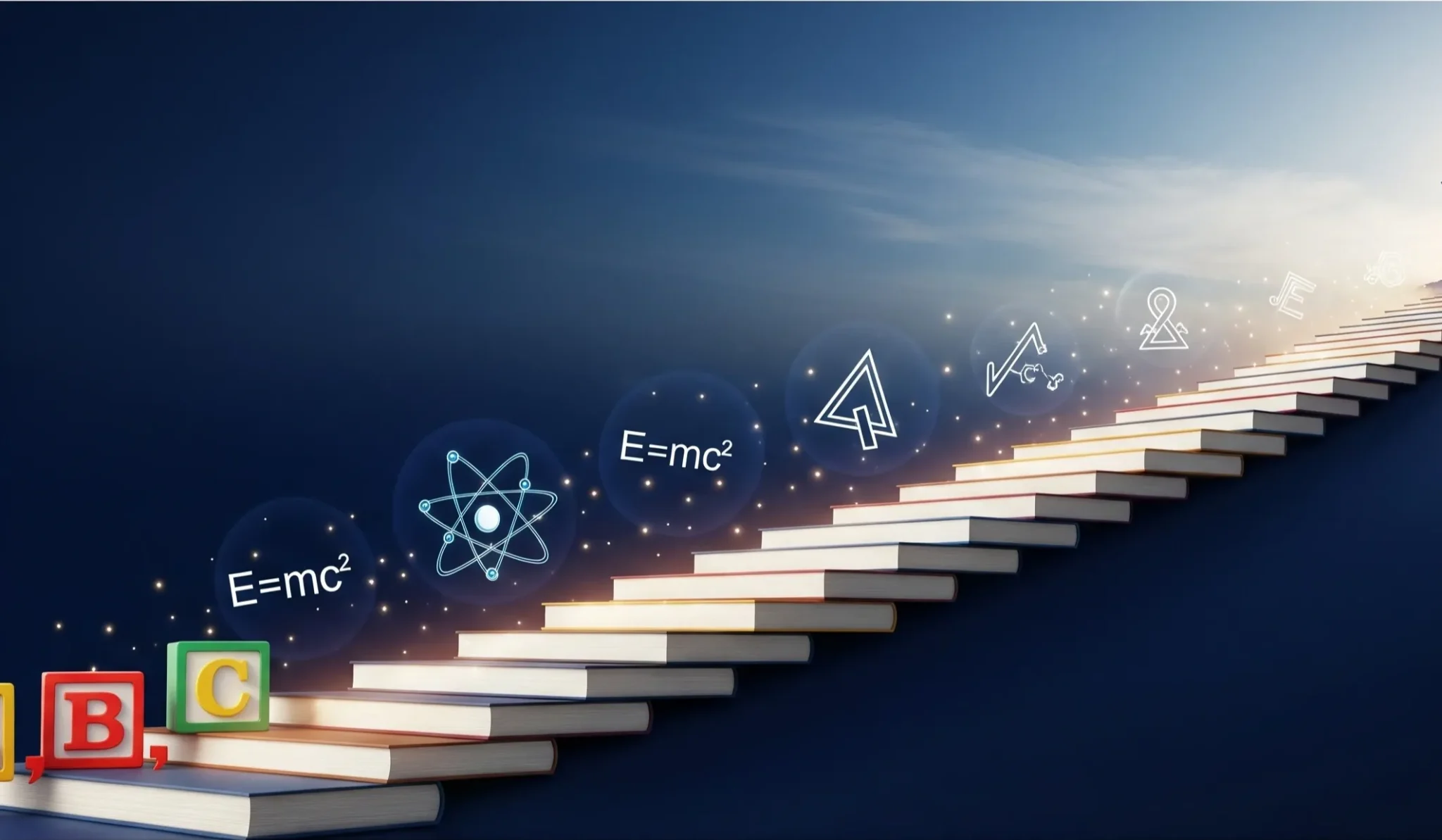
An inspiring image of a staircase made of books, showing the educational journey from primary learning blocks to advanced academic symbols, leading to success in Dubai.
GetYourTutors

Recent Reads

igcse maths

IGCSE Calculus: Differentiation, Gradients & Kinematics (H)

“In the Edexcel IGCSE Higher Tier syllabus, Calculus (Differentiation) allows us to analyze the rate of change of curves. The fundamental rule is: if y = ax^n, then the derivative dy/dx = anx^{n-1}. This technique is used for three main purposes: 1) Finding the Gradient of a curve at a specific point; 2) Locating Turning Points (Maximum/Minimum) by setting dy/dx = 0; and 3) Solving Kinematics problems, where differentiating displacement (s) gives velocity (v), and differentiating velocity gives acceleration (a).”

Read More »
igcse maths

IGCSE Real-Life Graphs: Distance, Velocity & Acceleration

“In the Edexcel IGCSE Higher Tier syllabus, Real-Life Graphs are used to model motion. Students must master two key types: 1) Distance-Time Graphs, where the gradient represents speed and a horizontal line means stationary; and 2) Velocity-Time Graphs, where the gradient represents acceleration and the area under the graph represents total distance travelled. Mastery involves calculating these values from complex, multi-stage graphs.”

Read More »
igcse maths

IGCSE Graphs: Solving Equations by Intersection (H)

“In the Edexcel IGCSE Higher Tier exam, Solving Equations Graphically allows you to find solutions without complex algebra. By plotting two functions (e.g., a quadratic curve and a linear line) on the same axes, the x-coordinates of their intersection points represent the solutions. A common high-tariff question involves using a pre-drawn curve (e.g., y = x^2 + 3x ) to solve a related equation (e.g., x^2 + 3x – 5 = 0 ) by determining and drawing a suitable straight line.”

Read More »
igcse maths

IGCSE Graphs: Quadratics, Cubics, Exponentials & Trig Guide

“In the Edexcel IGCSE Higher Tier syllabus, students must move beyond straight lines to master five key families of Non-Linear Graphs: 1) Quadratics (y=ax^2+bx+c) which form parabolas with distinct turning points; 2) Cubics (y=x^3) with their characteristic ‘S’ shape; 3) Reciprocals (y=1/x) featuring asymptotes; 4) Exponentials (y=k^x) showing rapid growth; and 5) Trigonometric Graphs (sin, cos, tan) which represent periodic waves. Mastery involves sketching these shapes by identifying intercepts, asymptotes, and turning points.”

Read More »
igcse maths

IGCSE Functions: Notation, Composite & Inverse Guide (H)

“In the Edexcel IGCSE Higher Tier syllabus, Function Notation replaces ‘y=’ with ‘f(x)=’ to describe mathematical relationships. Mastery involves three advanced skills: 1) Evaluating Functions (substituting inputs); 2) Composite Functions (fg(x)), which involves applying one function inside another (working right-to-left); and 3) Inverse Functions (f^{-1}(x)), which reverse the operation. Students must also understand Domain (valid inputs) and Range (possible outputs) to access top grades.”

Read More »
igcse maths

IGCSE Sequences: Linear & Quadratic Nth Term Formulae

“In the Edexcel IGCSE Higher Tier syllabus, finding the nth term is a critical skill. For Linear Sequences (constant difference), use the formula dn + c. For Quadratic Sequences (constant second difference), use the standard algebraic coefficients method: set 2a equal to the second difference, 3a+b equal to the first difference, and a+b+c equal to the first term to solve for the formula an^2 + bn + c.”

Read More »