IGCSE Maths: Mastering Surds and Rationalising the Denominator (H)
In mathematics, accuracy is everything. While decimals like 1.41 are useful approximations, they are not exact. To perform precise calculations in engineering, architecture, and physics, we must use Surds.
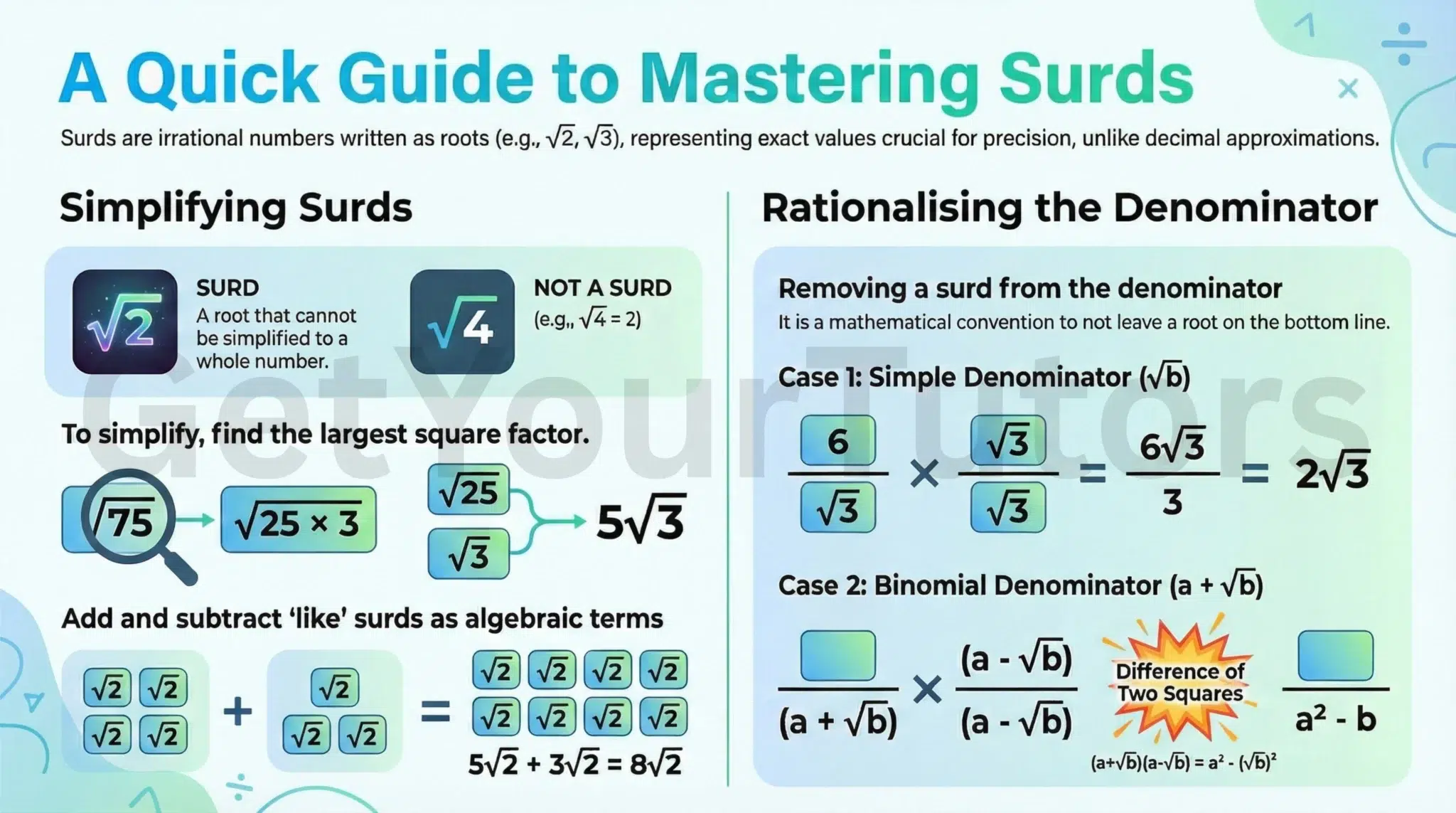
This guide covers Topic 1.11 Surds of the IGCSE Number System. This is a critical Higher Tier topic that appears frequently in non-calculator papers, requiring you to simplify complex roots and manipulate algebraic structures to "rationalise" fractions.
Understanding Surds: Core Concepts
A surd is an irrational number written as a root. It cannot be simplified into a whole number or a fraction.
- √4 = 2 (Rational - not a surd).
- √2 = 1.41421... (Irrational - this is a surd).
Surds allow us to work with exact values, which are closely linked to fractional indices (since √x = x½).
The Laws of Surds
Treat surds like algebraic variables (like x or y) when adding or subtracting, and use the following multiplication/division rules:
| Rule | Formula | Example |
|---|---|---|
| Multiplication | √a × √b = √(ab) | √3 × √2 = √6 |
| Division | √a√b = √ab | √10√2 = √5 |
| Squaring | (√a)2 = a | (√5)2 = 5 |
Simplifying Surds
Just as we simplify fractions, we must simplify surds. A surd is in its simplest form when the number inside the root has no square factors.
Method:
- Find the largest square factor of the number inside the root (4, 9, 16, 25, 36...).
- Split the root using the multiplication rule.
- Evaluate the square root of the square number.
Example: Simplify √75
√75 = √(25 × 3)
= √25 × √3
= 5√3
Rationalising the Denominator (H)
It is a mathematical convention that we never leave a surd in the denominator (bottom) of a fraction. The process of moving the root to the numerator is called rationalising the denominator.
Case 1: Simple Denominator
If the fraction is in the form a√b, multiply the top and bottom by √b.
Example: 6√3 × √3√3 = 6√33 = 2√3.
Case 2: Complex (Binomial) Denominator
If the denominator contains two terms (e.g., 3 + √2), you must multiply the top and bottom by the conjugate.
- The conjugate of (a + √b) is (a - √b).
- The conjugate of (a - √b) is (a + √b).
This creates a "Difference of Two Squares" scenario (x2 - y2), which eliminates the surd from the bottom.
Step-by-Step Worked Examples
Question: Simplify √50 + √18.
Methodology: You cannot add surds directly. Simplify them first to find a common root.
Solution:
- Simplify √50: √(25 × 2) = 5√2.
- Simplify √18: √(9 × 2) = 3√2.
- Add "like terms": 5√2 + 3√2 = 8√2.
Answer: 8√2.
Question: Expand and simplify (2 + √3)(2 - √3).
Solution: Use FOIL (First, Outer, Inner, Last).
- First: 2 × 2 = 4.
- Outer: 2 × (-√3) = -2√3.
- Inner: √3 × 2 = +2√3.
- Last: √3 × (-√3) = -3.
- Combine: 4 - 2√3 + 2√3 - 3.
- The surds cancel out: 4 - 3 = 1.
Answer: 1.
Question: Rationalise the denominator and simplify: 104 + √6.
Methodology: Multiply numerator and denominator by the conjugate (4 - √6).
Solution:
- Set up calculation: 104 + √6 × 4 - √64 - √6
- Multiply Numerator: 10(4 - √6) = 40 - 10√6.
- Multiply Denominator (Difference of Two Squares):
(4 + √6)(4 - √6) = 42 - (√6)2
= 16 - 6 = 10. - Combine fraction: 40 - 10√610.
- Simplify: Divide both terms by 10.
4 - √6.
Answer: 4 - √6.
Real-World Application (Global Context)
Surds are essential in construction and engineering for exact calculations of distance and structural integrity.
Scenario: Diagonal Bracing
An engineer is designing a square support frame for a bridge. The sides of the square are exactly 1 metre long. To strengthen the frame, a diagonal brace is added.
Using Pythagoras' Theorem (a2 + b2 = c2):
- c2 = 12 + 12
- c2 = 2
- c = √2 meters.
If the engineer rounds this to 1.41m, a gap of several millimeters might exist. By keeping the value as √2 during calculations, the manufacturing machines can cut the steel to the highest possible precision, ensuring the bridge is safe and stable.
Exam Technique and Common Pitfalls
1. The "Show Your Working" Trap
Questions often state "Show your working clearly." If you type √75 + √27 into a calculator and write 8√3, you will score zero marks. You must show the decomposition: √(25×3) + √(9×3).
2. Simplifying the Final Answer
When rationalising, students often stop at 10 + 5√25. Always check if the numerator terms share a common factor with the denominator. Here, divide everything by 5 to get 2 + √2.
3. Notation
Extend the root line over the entire number. √2 5 is confusing; write √25 clearly.
This topic is a critical component of mastering non-calculator skills required for the top grades.
Summary Checklist and Next Steps
Checklist:
- [ ] I can simplify surds by identifying square factors (e.g., √12 = 2√3).
- [ ] I can add and subtract surds by collecting like terms.
- [ ] I can multiply surds and expand brackets involving roots.
- [ ] I can rationalise a simple denominator (multiply by √a/√a).
- [ ] (H) I can rationalise a binomial denominator using the conjugate.
Practice Resources
Mastering surds and rationalising the denominator requires practice. Use our dedicated worksheet to test your skills on simplifying roots and complex binomial denominators.
Download Topic Worksheet: Surds & Rationalising the Denominator
Looking for more practice? Access our complete library of IGCSE maths worksheets and answers:
Get Free IGCSE Edexcel Maths Worksheets & Answers
Next Steps:
Congratulations! You have completed Section 1: Numbers and the Number System. You have built a robust toolkit of arithmetic and algebraic skills. The next logical step is to apply these skills to variables in Section 2: Equations, Formulae, and Identities, starting with algebraic manipulation.