IGCSE Linear Equations: Solving with Brackets & Fractions
Solving linear equations is the "bread and butter" of algebra. It is the process of finding the exact value of an unknown variable (usually x) that makes an equation true. In the Edexcel IGCSE 4MA1 Higher Tier exam, you will move beyond simple one-step equations to complex problems involving brackets, fractions, and variables on both sides.
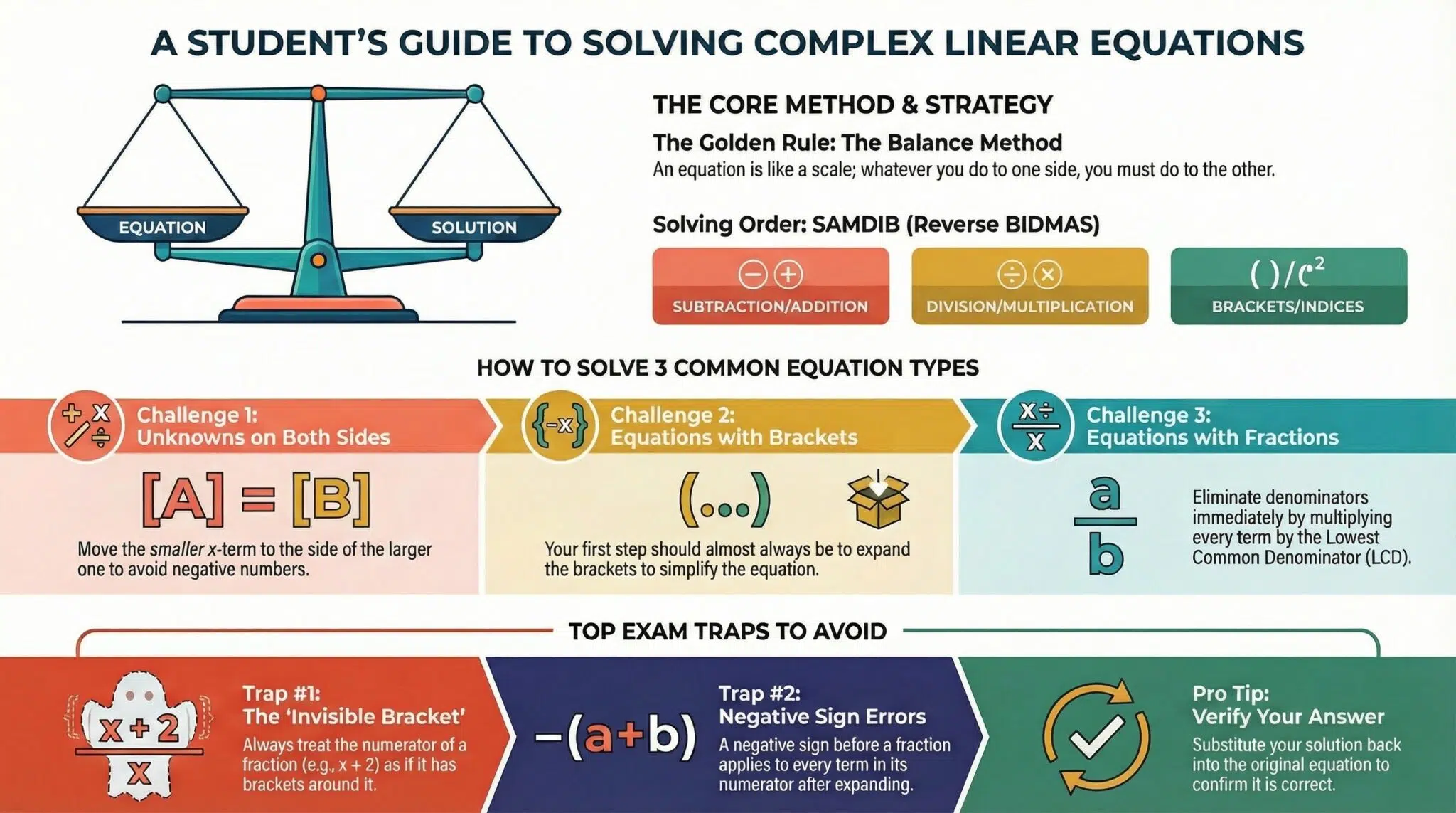
This guide covers Topic 2.4 of the IGCSE Algebra Hub, providing you with a systematic "Balance Method" to tackle any linear equation with confidence.
The Golden Rule: The Balance Method
An equation is like a balance scale. Whatever you do to one side (add, subtract, multiply, divide), you must do to the other side to keep it balanced.
Goal: Isolate x so the equation reads x = ...
Order of Operations for Solving (SAMDIB)
When solving, you generally work in the reverse order of BIDMAS:
- Subtraction/Addition: Move loose numbers first.
- Division/Multiplication: Isolate the x term.
- Brackets/Indices: Deal with grouping symbols (usually by expanding first).
Solving Complex Linear Equations
Higher Tier questions often include hurdles that you must clear before solving.
Type 1: Unknowns on Both Sides
If you have x on the left and right (e.g., 5x + 2 = 3x - 4), you must collect them.
- Strategy: Move the smaller x term to the side of the larger x term. This keeps the x value positive and reduces arithmetic errors.
Type 2: Equations with Brackets
If an equation contains brackets, your first step is almost always to expand the brackets.
- Example: 3(x + 4) = 18 → 3x + 12 = 18.
Type 3: Equations with Fractions (H)
Fractions are the most common cause of lost marks. The safest strategy is to eliminate the denominator immediately.
- Single Fraction: Multiply both sides by the denominator.
- Multiple Fractions: Multiply every term by the Lowest Common Denominator (LCD).
Key Operations Summary
| If you see... | You do... |
|---|---|
| + (Addition) | - (Subtraction) |
| - (Subtraction) | + (Addition) |
| × (Multiplication) | ÷ (Division) |
| ÷ (Division) | × (Multiplication) |
Step-by-Step Worked Examples
Question: Solve 7x - 3 = 3x + 17.
Methodology: Identify the smaller x term (3x) and remove it.
Solution:
- Subtract 3x from both sides:
(7x - 3x) - 3 = 17
4x - 3 = 17 - Add 3 to both sides:
4x = 20 - Divide by 4:
x = 5
Answer: x = 5.
Question: Solve 4(2x - 3) = 5x + 6.
Solution:
- Expand the brackets:
8x - 12 = 5x + 6 - Move smaller x (5x):
(8x - 5x) - 12 = 6
3x - 12 = 6 - Add 12 to both sides:
3x = 18 - Divide by 3:
x = 6
Answer: x = 6.
Question: Solve x + 23 - 2x - 14 = 2.
Methodology: Eliminate denominators by multiplying by the Lowest Common Multiple (LCM) of 3 and 4, which is 12. Watch out for the negative sign!
Solution:
- Multiply EVERY term by 12:
12 × (x + 2)3 - 12 × (2x - 1)4 = 12 × 2 - Simplify fractions:
4(x + 2) - 3(2x - 1) = 24 - Expand brackets (The Trap):
4x + 8 - 6x + 3 = 24
(Note: -3 × -1 = +3) - Collect like terms:
-2x + 11 = 24 - Solve: Subtract 11.
-2x = 13 - Divide:
x = -6.5
Answer: x = -6.5.
Real-World Application (Global Context)
Linear equations are used universally in business to calculate break-even points.
Scenario: The Break-Even Point
A coffee shop has fixed costs (rent, staff) of $200 per day. Each cup of coffee costs $1.50 to make and is sold for $4.00. How many cups (x) must be sold to break even?
Cost Equation: C = 200 + 1.50x
Revenue Equation: R = 4.00x
To break even, Revenue must equal Cost (R = C):
- 4x = 200 + 1.5x
- Subtract 1.5x: 2.5x = 200
- Divide by 2.5: x = 80.
The shop must sell exactly 80 cups to cover costs. Any sale above 80 is profit.
Exam Technique and Common Pitfalls
1. The "Invisible Bracket" Error
In a fraction like x + 23, the numerator implicitly has brackets around it: (x + 2). When you multiply to remove the denominator, remember to treat the numerator as a single group.
2. Negative Sign Distribution
Example 3 demonstrated the most common high-level error. When subtracting a fraction, the negative sign applies to every term in the numerator.
Incorrect: -3(2x - 1) → -6x - 3
Correct: -3(2x - 1) → -6x + 3
3. Verifying Your Answer
You can always check if you are correct. If you find x = 6 in Example 2, substitute it back into the original equation.
LHS: 4(2(6) - 3) = 4(9) = 36.
RHS: 5(6) + 6 = 36.
It matches, so you get full marks. Speed and accuracy in this topic are vital for expert algebraic problem solving.
Summary Checklist and Next Steps
Checklist:
- [ ] I can solve simple linear equations using the balance method.
- [ ] I can solve equations with unknowns on both sides by moving the smaller term.
- [ ] I can solve equations with brackets by expanding first.
- [ ] (H) I can solve equations with fractions by multiplying by the LCD.
- [ ] I check my answer by substituting the value back into the original equation.
Practice Resources
Mastering linear equations requires consistent practice. Use our dedicated worksheet to test your skills on solving equations with brackets, fractions, and variables on both sides.
Download Topic Worksheet: Solving Linear Equations
Looking for more practice? Access our complete library of IGCSE maths worksheets and answers:
Get Free IGCSE Edexcel Maths Worksheets & Answers
Next Steps:
Now that you can solve for a single variable, the next challenge is finding two variables at once. Move on to Topic 2.5 Simultaneous Equations.