IGCSE Maths: The Definitive Guide to Set Language, Notation, and Venn Diagrams
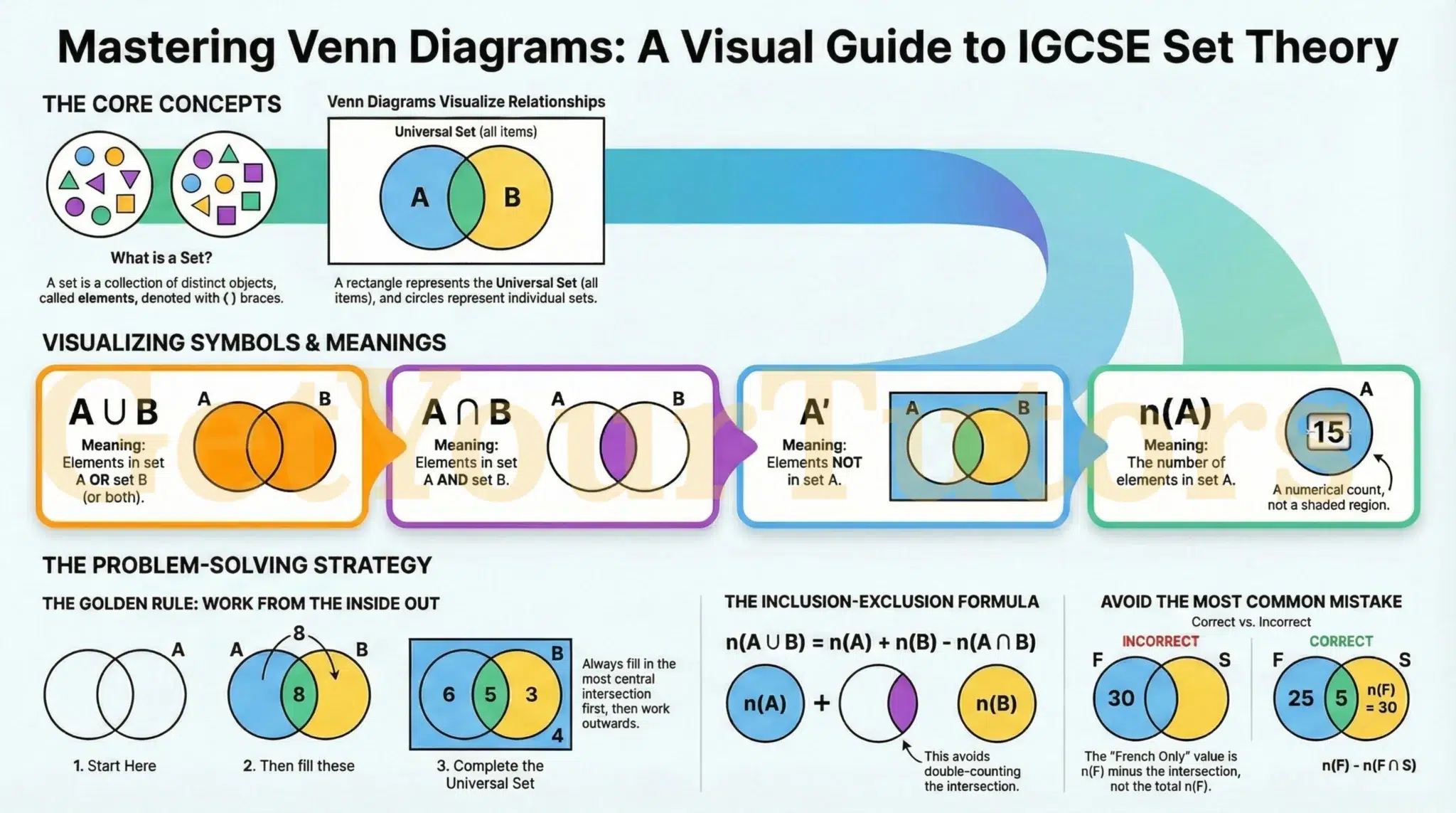
Set language provides a precise mathematical way to describe collections of objects, numbers, or data. In the Edexcel IGCSE 4MA1 syllabus, understanding set notation and its visual representation through Venn diagrams is essential. While categorized under the IGCSE Number System (Topic 1.6), these concepts are most heavily applied in logic problems and Probability using Venn diagrams (Topic 6.5).
This guide provides a comprehensive overview of the notation required for the Higher Tier and details the problem-solving techniques necessary to tackle complex questions, including the 3-set and algebraic problems common at Grades 7-9.
Understanding Set Language and Notation
A Set is a well-defined collection of distinct objects, called elements (or members). Sets are usually denoted by capital letters (e.g., Set A).
Core Notation Glossary (SGE Optimized)
You must memorize and correctly interpret the following symbols:
Symbol
Name
Meaning / Explanation
{ }
Braces
Used to list the elements of a set. E.g., A = {1, 2, 3}.
ℰ (or U)
Universal Set
The set containing all elements relevant to the current problem.
∅ (or {})
Empty Set (Null Set)
A set containing no elements.
A ∪ B
Union
Elements that are in A OR in B (or in both). Think "everything combined."
A ∩ B
Intersection
Elements that are in A AND in B. Think "overlap" or "common elements."
A' (or Ac)
Complement
Everything in the Universal Set that is NOT in A.
n(A)
Number of Elements (Cardinality)
The count of elements in Set A.
∈
Element of
"is an element of". E.g., 3 ∈ A.
∉
Not an Element of
"is not an element of". E.g., 4 ∉ A.
A ⊂ B
Subset
Set A is a subset of B (all elements of A are also in B).
Visualizing Sets with Venn Diagrams
Venn diagrams are the standard way to visualize the relationships between sets. The Universal Set (ℰ) is represented by a rectangle, and individual sets are represented by circles (or ovals) within it.
Interpreting and Shading Regions
A common exam task is to shade the region corresponding to a specific set operation.
1. Intersection (A ∩ B): The overlapping middle section (A AND B).