IGCSE Linear Graphs: y=mx+c, Parallel & Perpendicular Lines (H)
Coordinate Geometry connects algebra and visuals. In the Edexcel IGCSE 4MA1 Higher Tier exam, mastering the properties of straight lines is critical not just for graph questions, but as a foundation for Calculus (differentiation). This guide covers Topic 3.3 of the IGCSE Functions & Graphs Hub.
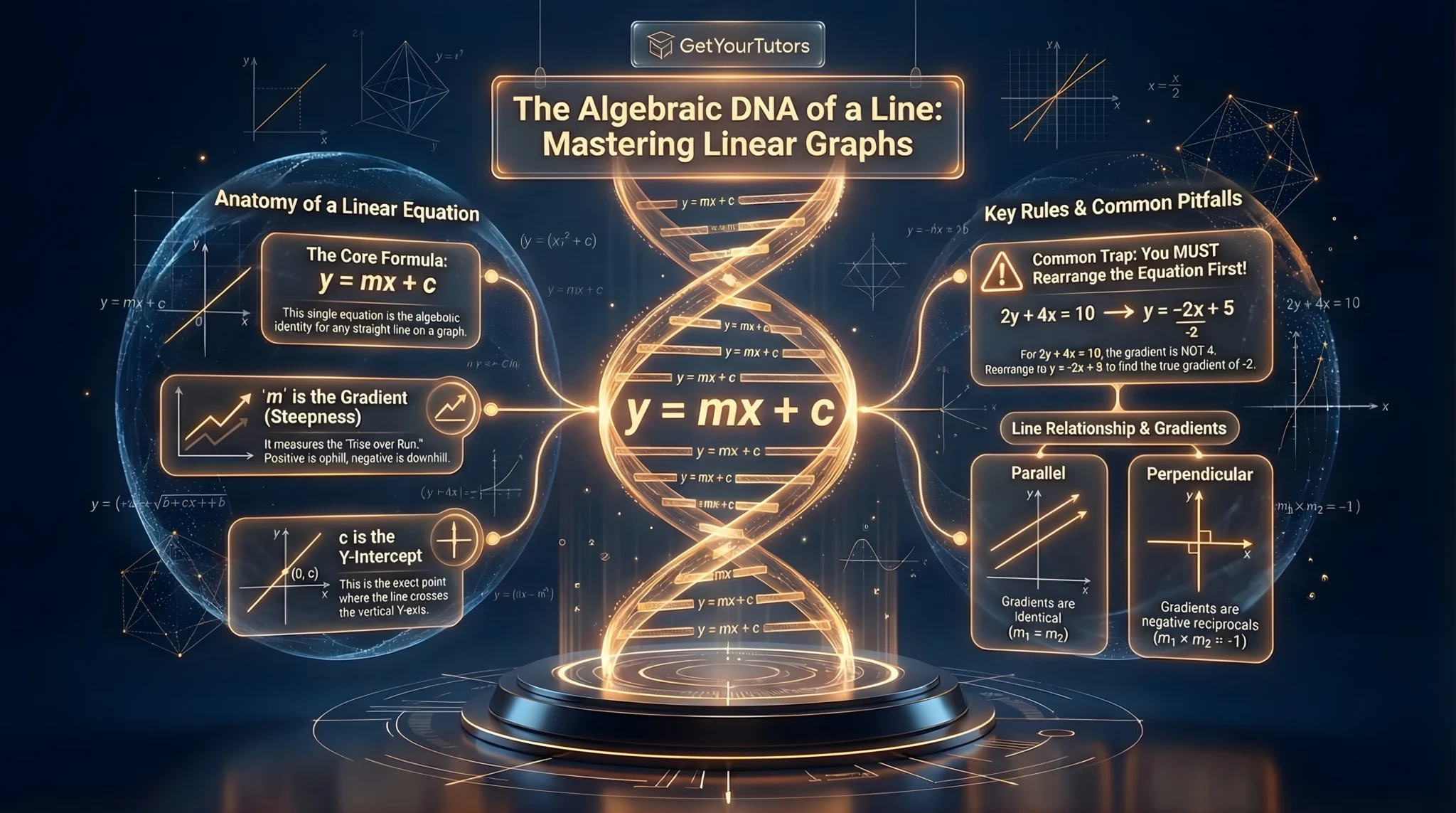
We will move beyond simple plotting to understanding the algebraic DNA of a line: its gradient, intercept, and relationship to other lines (parallel and perpendicular).
1. The Equation of a Straight Line
Every straight line can be written in the form:
y = mx + c
- m (Gradient): The "steepness" of the line. A positive m means the line goes uphill; a negative m means it goes downhill.
- c (y-intercept): The point where the line crosses the vertical y-axis (where x=0).
Important: The Rearrangement Trap
If an equation is given as 2y + 4x = 10, the gradient is NOT 4. You must rearrange the equation to make y the subject first.
- 2y = -4x + 10
- y = -2x + 5
- Gradient (m) = -2. Intercept (c) = 5.
2. Calculating the Gradient (m)
To find the gradient between two points (x1, y1) and (x2, y2), we calculate the "Rise over Run".
m = Change in yChange in x = y2 - y1x2 - x1
3. Parallel and Perpendicular Lines (H)
This is a core Higher Tier concept.
| Line Type | Relationship | Algebraic Rule |
|---|---|---|
| Parallel | Never touch, same direction. | m1 = m2 (Same Gradient) |
| Perpendicular | Cross at 90° (Right Angles). | m1 × m2 = -1 (Negative Reciprocal) |
Tip for Perpendiculars: Flip the fraction and swap the sign.
If m = 2 (or 2/1), the perpendicular gradient is -1/2.
If m = -3/4, the perpendicular gradient is 4/3.
4. Finding the Equation of a Line
To find the full equation y = mx + c, you need two things:
- The Gradient (m).
- One Point on the line (x, y).
Method: Substitute m, x, and y into y = mx + c and solve for c.
Step-by-Step Worked Examples
Question: Find the equation of the line passing through A(2, 5) and B(6, 13).
Solution:
- Find Gradient (m):
m = 13 - 56 - 2 = 84 = 2. - Substitute into y = mx + c:
Use point A(2, 5). x=2, y=5, m=2.
5 = 2(2) + c. - Solve for c:
5 = 4 + c → c = 1.
Equation: y = 2x + 1.
Question: Find the equation of the line parallel to y = 3x + 7 that passes through the point (4, 1).
Methodology: Parallel lines have the same gradient.
Solution:
- Identify m: Old gradient = 3. New gradient = 3.
- Substitute: Use (4, 1) and m=3.
y = mx + c
1 = 3(4) + c - Solve for c:
1 = 12 + c → c = -11.
Equation: y = 3x - 11.
Question: Find the equation of the perpendicular bisector of the line segment joining P(-2, 4) and Q(8, -2).
Methodology: A bisector passes through the midpoint at a 90° angle.
Solution:
- Find Midpoint: Average the coordinates.
x = (-2+8)/2 = 3. y = (4-2)/2 = 1. Midpoint M(3, 1). - Find Gradient of PQ:
m = -2 - 48 - (-2) = -610 = -35. - Find Perpendicular Gradient:
Flip -3/5 → 53. - Find Equation: Use M(3, 1) and m = 5/3.
1 = 53(3) + c
1 = 5 + c → c = -4.
Answer: y = 53x - 4.
Real-World Application (Global Context)
Linear graphs are the simplest form of mathematical modeling, used in economics and science.
Scenario: Calibration of a Thermometer
A scientist needs to calibrate a new temperature sensor.
• At 0°C (freezing point), the sensor reads 200mV. Point A(0, 200).
• At 100°C (boiling point), the sensor reads 600mV. Point B(100, 600).
Assuming the relationship is linear, the scientist finds the equation of the line connecting A and B.
m = (600-200) / (100-0) = 4.
c = 200 (y-intercept).
Equation: V = 4T + 200.
This simple linear equation allows the software to instantly convert any voltage reading (V) into a temperature (T).
Exam Technique and Common Pitfalls
1. The "Rearranging" Trap
Students often see 2y + 4x = 10 and assume the gradient is 4. This is incorrect. You must make y the subject first.
2y = -4x + 10 → y = -2x + 5. The gradient is -2.
2. Negative Reciprocals
When finding a perpendicular gradient, remember to flip AND change the sign.
If m = 3, perpendicular m = -1/3.
If m = -1/2, perpendicular m = 2.
3. Midpoints vs. Lengths
Often, coordinate geometry questions are combined. Remember:
• Midpoint: Average the coordinates.
• Length: Use Pythagoras' Theorem.
Mastering coordinate geometry is essential, as it frequently merges algebra and geometry in high-mark questions.
Summary Checklist and Next Steps
Checklist:
- [ ] I can rearrange any linear equation into the form y = mx + c.
- [ ] I can calculate the gradient between two points.
- [ ] I can find the equation of a line given the gradient and one point.
- [ ] (H) I know the rule for perpendicular gradients (m1 × m2 = -1).
Practice Resources
Mastering linear graphs requires practice, especially with perpendicular lines and finding equations. Use our dedicated worksheet to test your skills on coordinate geometry.
Download Topic Worksheet: Linear Graphs & Equations
Looking for more practice? Access our complete library of IGCSE maths worksheets and answers:
Get Free IGCSE Edexcel Maths Worksheets & Answers
Next Steps:
Linear graphs are just the beginning. The next step involves curves. Move on to Topic 3.4 Graphs of Functions to explore quadratics, cubics, and reciprocals.