IGCSE Maths: Mastering Decimals and Recurring Fractions (H)
Decimals are a fundamental part of the IGCSE Number System. While basic operations with decimals are often covered in Lower Secondary, the Edexcel IGCSE 4MA1 Higher Tier requires a much deeper understanding. Specifically, you must be able to rigorously prove the link between recurring decimals and fractions using algebra.
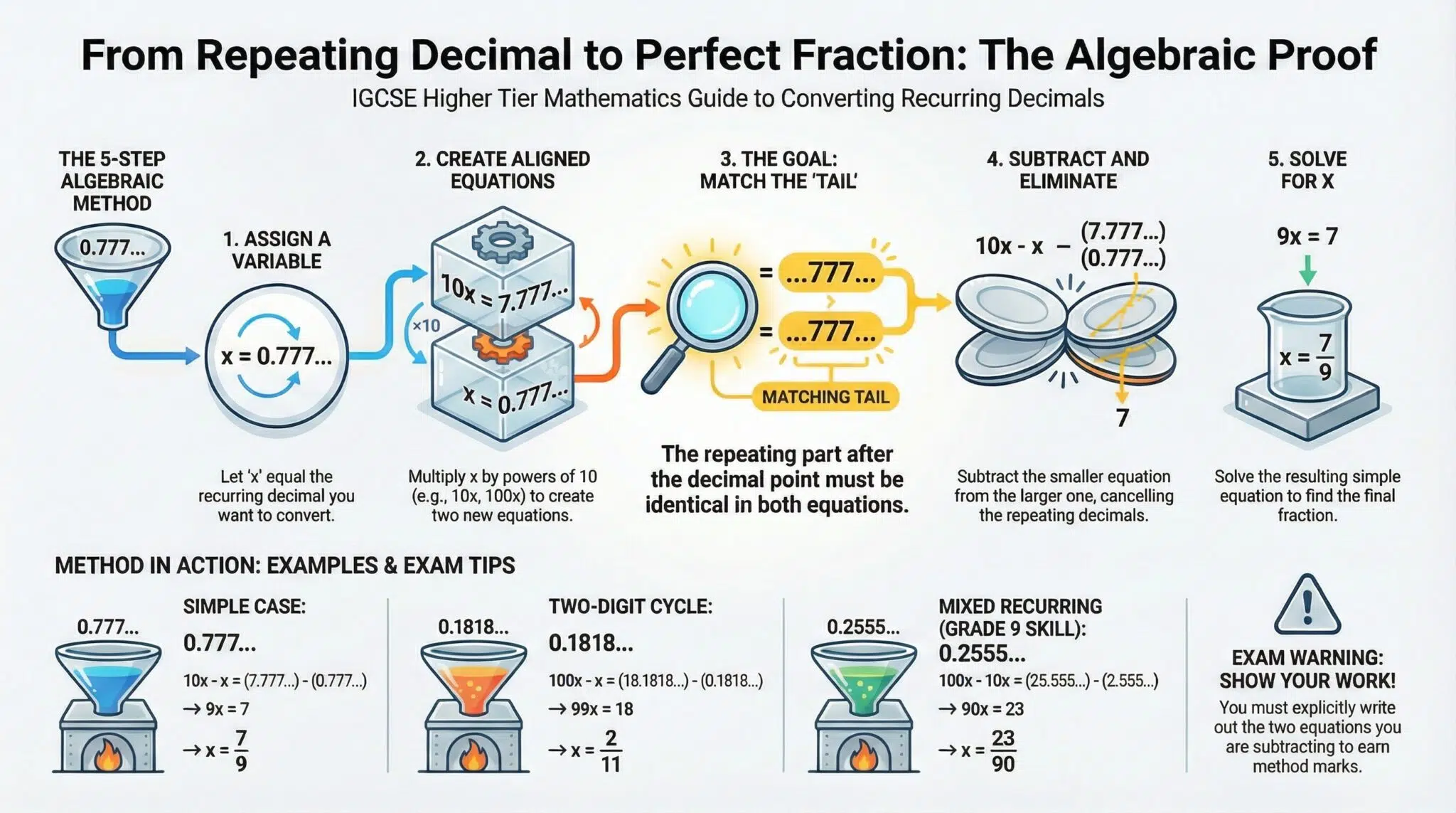
This guide covers Topic 1.4, taking you from the basics of ordering and place value to the "Grade 8/9" skill of algebraically proving fraction conversions—a frequent high-tariff question.
1. Types of Decimals
In mathematics, decimals fall into three categories based on their rationality:
| Type | Description | Rational? | Example |
|---|---|---|---|
| Terminating | Stops after a certain number of decimal places. | Yes (Fraction) | 0.375 |
| Recurring | A pattern of digits repeats forever. | Yes (Fraction) | 0.333..., 0.1414... |
| Irrational | Goes on forever with no repeating pattern. | No | π, √2 |
2. Ordering Decimals
To order decimals accurately, you must compare digits in the same place value column.
Strategy: Add "placeholder zeros" so all numbers have the same length.
- Compare: 0.4, 0.405, 0.045, 0.45
- Pad them: 0.400, 0.405, 0.045, 0.450
- Order (Ascending): 0.045, 0.4, 0.405, 0.45
3. The Grade 9 Skill: Recurring Decimals to Fractions (H)
Converting a terminating decimal is easy (0.7 = 7/10). Converting a recurring decimal requires an algebraic method. Exam questions often use the command word "Prove algebraically..." which means a calculator answer alone gets zero marks.
The Algebraic Method
The goal is to create two equations where the "recurring tail" after the decimal point is identical. When you subtract them, the decimal part disappears.
- Let x = the recurring decimal.
- Identify the repeating cycle.
- Multiply x by powers of 10 (10, 100, 1000) to create two equations where the decimal parts align perfectly.
- Subtract the smaller equation from the larger one.
- Solve the resulting linear equation.
Step-by-Step Worked Examples
Question: Prove algebraically that 0.777... (0.7̇) can be written as 79.
Solution:
- Let x = 0.7777...
- Multiply by 10 (one repeating digit):
10x = 7.7777... - Subtract x from 10x:
10x - x = 7.777... - 0.777...
9x = 7 - Solve:
x = 79.
Question: Convert 0.18̇18̇ (0.1818...) to a simplified fraction.
Solution:
- Let x = 0.181818...
- Multiply by 100 (two repeating digits):
100x = 18.181818... - Subtract x from 100x:
99x = 18 - Solve and simplify:
x = 1899
Divide by 9: x = 211
Answer: 211.
Question: Convert 0.2555... (0.25̇) to a fraction. Note: Only the 5 repeats.
Methodology: We need two equations where the decimal part is purely .555...
Solution:
- Let x = 0.2555...
- Multiply by 10 (to move the non-repeating '2' past the point):
10x = 2.555... (Equation A) - Multiply by 100 (to move one full cycle past the point):
100x = 25.555... (Equation B) - Subtract A from B:
100x - 10x = 25.555... - 2.555...
90x = 23 - Solve:
x = 2390.
Answer: 2390.
Real-World Application (Global Context)
Precision is critical in computing and finance. Computers work in binary, which often results in recurring decimals when converting to base-10.
Scenario: Financial Accuracy
In financial software, calculating interest might result in a recurring decimal like 1/3 (0.333...). If the computer truncates this to 0.33, a small error is introduced. Multiplied by millions of transactions, these "rounding errors" can result in significant financial discrepancies. Programmers use exact fractional representations rather than decimals to maintain 100% accuracy in banking systems.
Exam Technique and Common Pitfalls
1. Showing the Subtraction
To get the method marks (M1), you must write down the two equations you are subtracting (e.g., "100x = ..." and "10x = ..."). Simply writing the answer is insufficient for "Show that" questions.
2. The "Tail" Mismatch
When subtracting, ensure the decimal parts match exactly.
Incorrect: 100x (12.555) - x (0.125) = 12.43 (Decimals didn't cancel).
Correct: Use 100x (12.555) and 10x (1.255) so the .555... cancels out.
Mastering algebraic proofs like these is a specific skill that separates Grade 8 students from Grade 9 students.
Summary Checklist and Next Steps
Checklist:
- [ ] I can order decimals by comparing place values.
- [ ] I can convert terminating decimals to fractions (e.g., 0.4 = 4/10).
- [ ] I can convert simple recurring decimals (e.g., 0.555...) to fractions algebraically.
- [ ] (H) I can convert complex recurring decimals (e.g., 0.166...) using the subtraction method.
Practice Resources
Mastering the algebraic proof for recurring decimals requires practice. Use this worksheet to test your ability to convert both simple and complex recurring decimals.
Download Topic Worksheet: Decimals & Recurring Fractions
Need more practice materials? Access our full library of IGCSE maths worksheets and answers:
Get Free IGCSE Edexcel Maths Worksheets & Answers
Next Steps:
Now that you can handle exact numbers as decimals, the next logical step is Topic 1.5 Powers and Roots, where we explore indices and standard form.