IGCSE Calculus: Differentiation, Gradients & Kinematics (H)
Calculus is the mathematics of change. While straight lines have a constant gradient, curves do not. Differentiation allows us to find the exact gradient of a curve at any single point. In the Edexcel IGCSE 4MA1 Higher Tier syllabus, this is a gateway topic to A-Level mathematics, covering the basics of differentiation, turning points, and motion (kinematics).
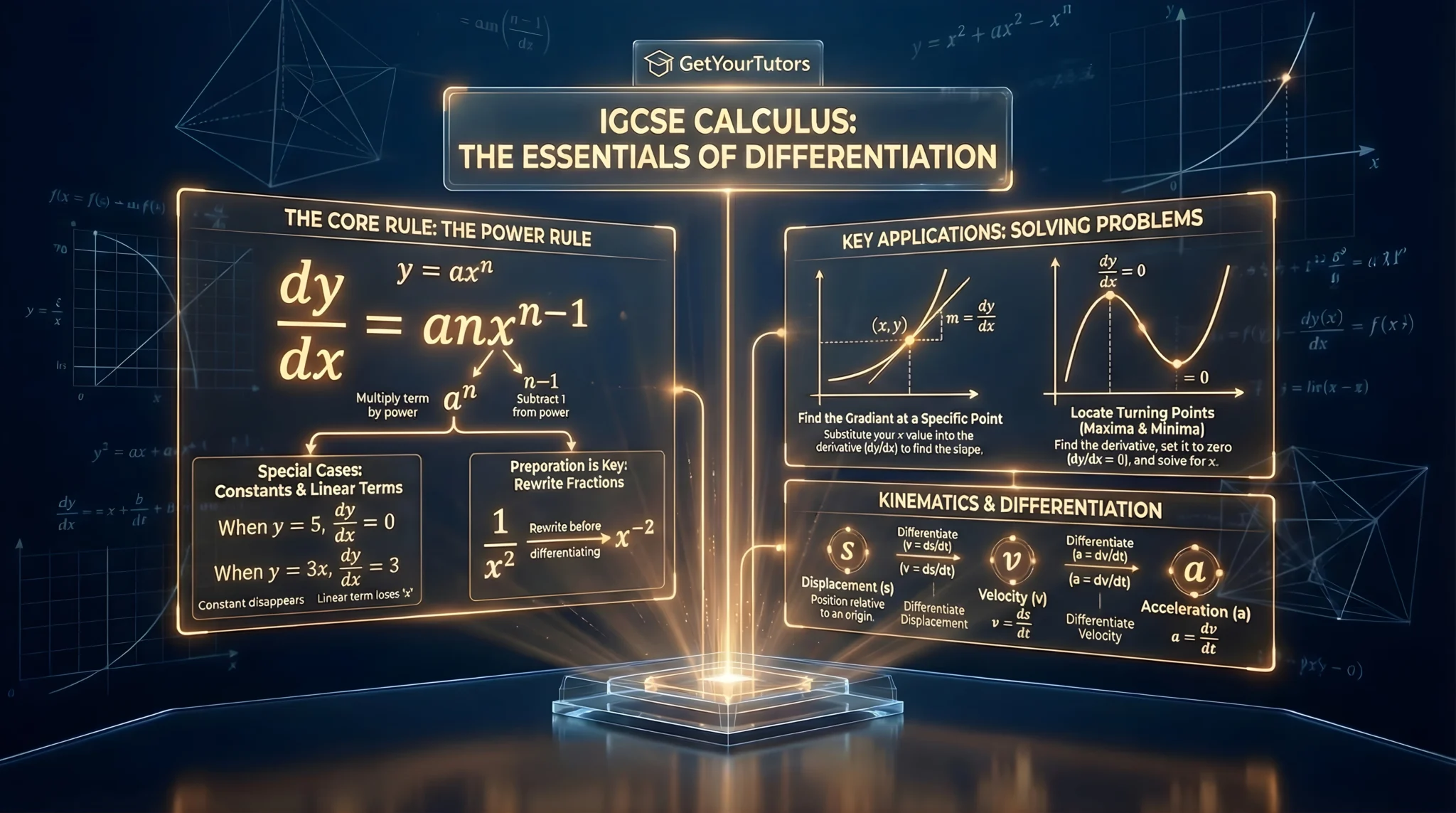
This guide covers Topic 3.7 of the IGCSE Functions & Graphs Hub, ensuring you are ready for these high-tariff Grade 9 questions.
1. Differentiation: The Power Rule
The process of finding the gradient function is called differentiation. The result is the derivative, written as dydx.
If y = axn, then dydx = anxn-1
Multiply by the power, then subtract 1 from the power.
Special Cases
- Constants disappear: If y = 5, dydx = 0 (A flat line has no gradient).
- Linear terms lose the x: If y = 3x, dydx = 3 (Linear lines have constant gradient).
- Preparation: You must rewrite fractions using laws of indices before differentiating.
- 1x → x-1
- 1x² → x-2
2. Applications of Differentiation
Once you have the gradient function (dy/dx), you can use it to solve two main types of problems.
A. Finding the Gradient at a Point
To find the "rate of change" or "gradient of the tangent" at a specific point x=a, simply substitute a into your dy/dx equation.
B. Finding Turning Points (Maxima and Minima)
A turning point is where the graph turns around (the peak or the trough). At these points, the tangent is horizontal.
Key Fact: At a turning point, dydx = 0.
To determine the nature of the turning point, find the Second Derivative (d²ydx²) by differentiating again.
- If d²ydx² > 0, it is a Minimum (U shape).
- If d²ydx² < 0, it is a Maximum (n shape).
3. Kinematics (Motion Calculus)
Calculus defines the relationship between Displacement (s), Velocity (v), and Acceleration (a).
| Concept | Symbol | Calculus Definition |
|---|---|---|
| Displacement | s | Position relative to origin. |
| Velocity | v | Rate of change of displacement. v = dsdt (Differentiate s) |
| Acceleration | a | Rate of change of velocity. a = dvdt (Differentiate v) |
Note: In this topic, 't' represents time, acting like 'x' in standard differentiation.
Step-by-Step Worked Examples
Question: Differentiate y = x³ + 4x.
Methodology: You cannot differentiate a fraction directly in IGCSE. Divide each term by x first.
Solution:
- Rewrite: y = x³x + 4x = x² + 4x⁻¹.
- Differentiate x²: 2x.
- Differentiate 4x⁻¹: -1 × 4x⁻² = -4x⁻².
- Combine: dydx = 2x - 4x⁻² (or 2x - 4x²).
Answer: 2x - 4x⁻².
Question: Find the coordinates of the turning points of the curve y = x³ - 3x² - 9x + 1.
Solution:
- Find dy/dx: 3x² - 6x - 9.
- Set to Zero: 3x² - 6x - 9 = 0.
- Solve: Divide by 3 → x² - 2x - 3 = 0.
Factorise: (x - 3)(x + 1) = 0.
x = 3, x = -1. - Find y-coordinates: Substitute x back into original y equation.
At x=3: y = 27 - 27 - 27 + 1 = -26. Point (3, -26).
At x=-1: y = -1 - 3 + 9 + 1 = 6. Point (-1, 6).
Answer: (3, -26) and (-1, 6).
Question: A particle moves such that s = 2t³ - 15t² + 24t. Find the acceleration of the particle when its velocity is zero.
Solution:
- Find Velocity (v = ds/dt): v = 6t² - 30t + 24.
- Find when v = 0: 6t² - 30t + 24 = 0.
Divide by 6: t² - 5t + 4 = 0.
(t - 4)(t - 1) = 0.
Velocity is zero at t = 1 and t = 4. - Find Acceleration (a = dv/dt): a = 12t - 30.
- Calculate a at t=1: 12(1) - 30 = -18 m/s².
- Calculate a at t=4: 12(4) - 30 = 18 m/s².
Answer: -18 m/s² and 18 m/s².
Real-World Application (Global Context)
Calculus is used to optimize resources, such as minimizing material usage for packaging.
Scenario: Maximizing Enclosure Area
A farmer has 100m of fencing to make a rectangular pen against a river (so only 3 sides need fencing). What dimensions give the maximum area?
- Let width = x. Length = 100 - 2x.
- Area A = x(100 - 2x) = 100x - 2x².
- To maximize, find dA/dx and set to 0.
- dA/dx = 100 - 4x = 0 → 4x = 100 → x = 25.
The optimal width is 25m, giving a max area of 1250m². Without calculus, this would require trial and error.
Exam Technique and Common Pitfalls
1. Notation Confusion
Be careful with notation.
• If the question uses y, write dy/dx.
• If the question uses f(x), write f'(x).
• If the question uses s and t, write ds/dt or v.
2. The Disappearing Constant
Remember that the derivative of a constant number (like +5 or -12) is zero. It disappears.
Error: Differentiating x² + 5 to get 2x + 5.
Correct: 2x.
3. Substituting into the Wrong Equation
This is the classic trap in turning point questions.
• To find x, solve dy/dx = 0.
• To find y (the coordinate), substitute x back into the original y=... equation, NOT the dy/dx equation.
Mastering Grade 9 calculus is essential for students aiming for the top grades, as these questions combine algebra, graphs, and physical reasoning.
Summary Checklist and Next Steps
Checklist:
- [ ] I can differentiate terms like axn, constants, and linear x terms.
- [ ] I can prepare equations involving fractions (e.g. 1/x) for differentiation.
- [ ] I can find the gradient of a curve at a specific point.
- [ ] I can find turning points and determine if they are Max or Min.
- [ ] I can derive expressions for v and a from s (Displacement).
Practice Resources
Mastering calculus requires practice, particularly in identifying turning points and solving kinematics problems. Use our dedicated worksheet to test your skills on differentiation and gradients.
Download Topic Worksheet: Calculus (Differentiation & Kinematics)
Looking for more practice? Access our complete library of IGCSE maths worksheets and answers:
Get Free IGCSE Edexcel Maths Worksheets & Answers
Next Steps:
You have now mastered the analytical side of graphs. The final piece of the puzzle is moving graphs around the grid. Move on to Topic 3.8 Transformations of Graphs.