What are "Progress Tests" (PTM/PTE) in Dubai?
Report card season is here. We decode the "Alphabet Soup" of GL Assessments and explain why the KHDA requires them for all British curriculum schools.
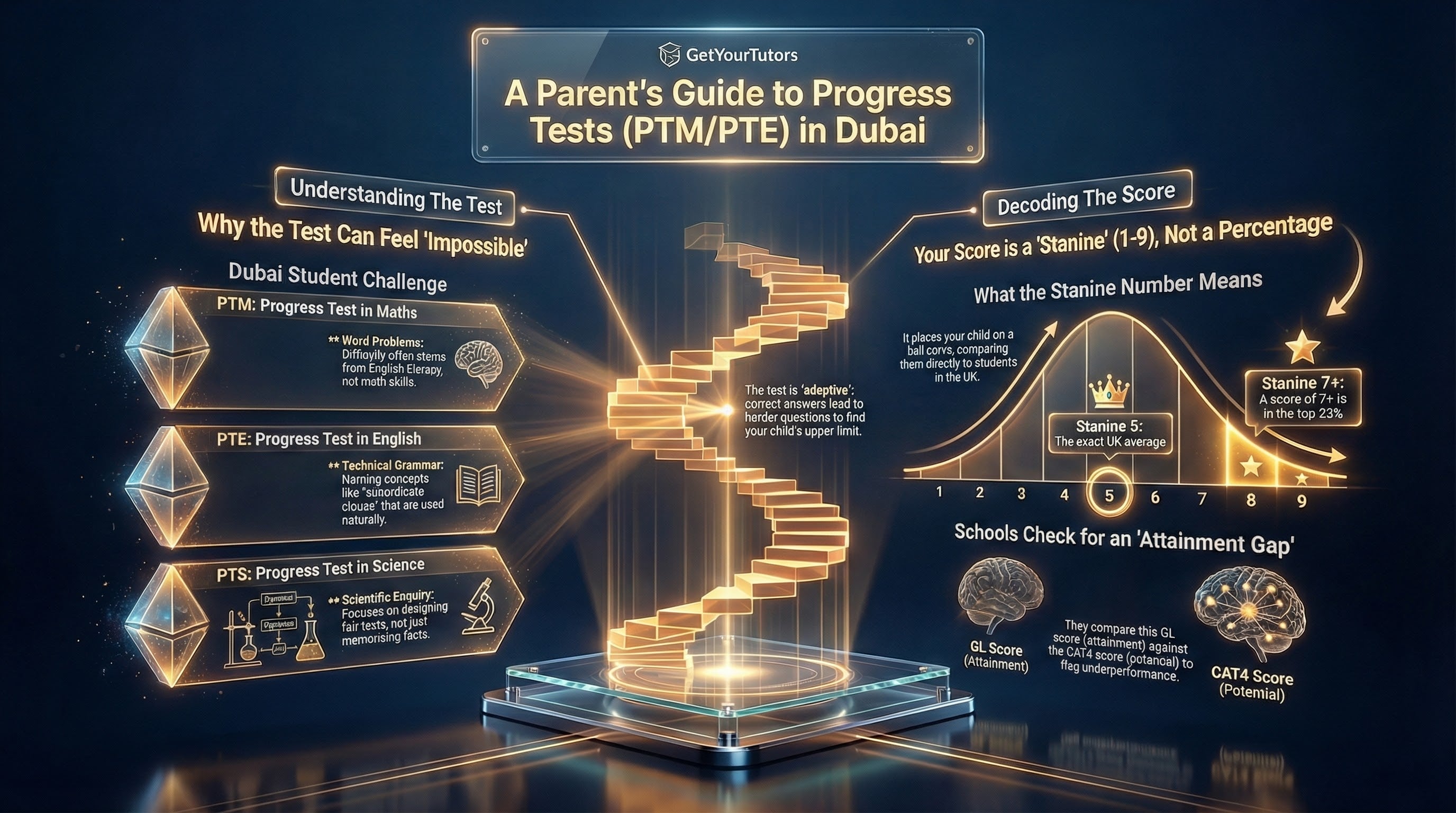
The KHDA Context
It is mandatory. The National Agenda Parameter requires Dubai private schools to benchmark students against international standards. GL Assessments prove to the KHDA that students are performing at (or above) UK levels.
Quick Answer: The Acronyms & Challenges
These tests are created by GL Education (UK). They are not just about "knowing the answer" but applying knowledge under pressure.
| Acronym | Full Name | The "Dubai Student" Challenge |
|---|---|---|
| PTM | Progress Test in Maths | Word Problems: Students often fail here not because of Math, but because of English literacy (understanding what the question asks). |
| PTE | Progress Test in English | Technical Grammar: Tests terms like "subordinate clause" or "fronted adverbial" which native speakers often use naturally but can't name. |
| PTS | Progress Test in Science | Scientific Enquiry: Focuses on how to design a fair test, rather than just memorizing facts about plants or forces. |
Video Guide: Why the Test Felt 'Impossible' & Stanine Scores Explained
Why Parents Panic: "Adaptive" Testing
A common complaint we hear: "My child came home crying saying the test was impossible!"
Do not panic. This is actually a good sign.
GL Tests are Adaptive. This means the computer reacts to your child:
- Answer Correctly? The next question gets harder.
- Answer Incorrectly? The next question gets easier.
If the test felt "hard," it means your child was answering consistently correctly, pushing the system to find their upper limit (Attainment Ceiling).
Decoding the Score: The "Stanine" (1-9)
You won't get a percentage. You get a Stanine (Standard Nine). This places your child on a bell curve against UK students.
Below Average (1-3)
This indicates a gap in curriculum access. Schools will often suggest an Individual Education Plan (IEP) or external support.
Average (4-6)
Stanine 5 is the exact average (Standard Age Score 100). This means your child is exactly where they should be.
High Performance (7-9)
Stanine 7+ represents the top 23%. This is often the requirement for "Top Set" placement in competitive Secondary schools like Dubai College.
The Attainment Gap
Schools compare this GL Score (Attainment) against the CAT4 Score (Potential). If GL is lower than CAT4, the school flags it as "Underperformance."
Is there a gap in the report?
A low PTE score often just means "Technical Grammar" is missing. Our qualified teachers can fix these specific curriculum gaps in 12 weeks.
Find a Remedial Tutor