The Middle School Math Comparison: KS3 (British) vs. MYP (IB) vs. American Common Core Expectations in Dubai
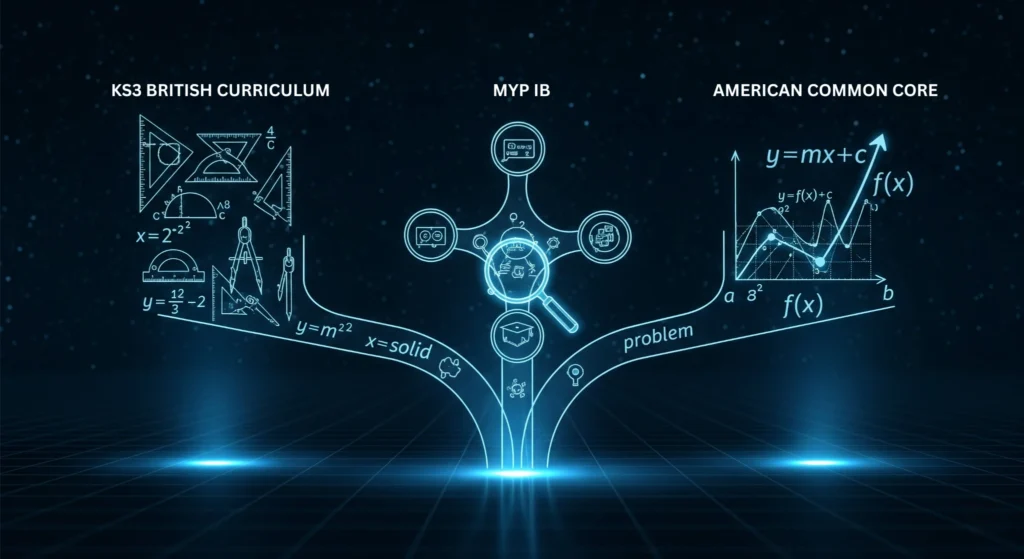
The middle school years (typically Years 7-9 or Grades 6-8) are arguably the most critical phase in a student’s mathematical journey. This period serves as the essential bridge between the foundational numeracy skills developed in primary school and the rigorous demands of advanced high school mathematics (GCSE, IB DP, A-Levels, or AP).
In Dubai, parents are faced with a diverse and sometimes confusing array of options. The three dominant systems—British Key Stage 3 (KS3), the IB Middle Years Programme (MYP), and the American Common Core—are all implemented in KHDA-rated ‘Very Good’ and ‘Outstanding’ schools across the Emirate.
While all three curricula aim to develop confident, capable mathematicians ready for high school, their underlying philosophies, assessment styles, and content emphasis differ significantly. Understanding these nuances is crucial for choosing the right educational pathway and supporting your child effectively.
Executive Summary: Key Takeaways
British KS3 (Years 7-9): Focuses on structured learning, breadth of content, and developing procedural fluency. It is the most direct pathway to GCSE/IGCSE and emphasizes standardized assessment and exam readiness.
IB MYP (Grades 6-10): Emphasizes inquiry-based learning, conceptual understanding, and real-world application. It uses a unique criteria-based assessment system (Criteria A-D) rather than traditional grading, prioritizing critical thinking for the IB DP.
American Common Core (Grades 6-8): Focuses on coherence, rigor, and a sequential mastery of concepts. Its defining feature is a strong emphasis on “Algebra Readiness” by Grade 8. Assessment often involves standardized MAP testing.
Rigor is Different, Not Necessarily Higher: No single curriculum is definitively “harder.” MYP is challenging in its demand for communication and investigation; KS3 is fast-paced in procedural math; Common Core is demanding in its algebraic expectations.
The Core Philosophies: Inquiry, Structure, and Sequence
The fundamental differences between these curricula stem from their underlying educational philosophies.
The British Philosophy (Structure and Depth): The KS3 curriculum is derived from the English National Curriculum. It emphasizes a structured progression through key mathematical domains, ensuring students acquire a broad knowledge base and the procedural skills necessary for standardized examinations.
The IB Philosophy (Inquiry and Conceptual Understanding): The MYP is driven by inquiry. It aims to develop students who are critical thinkers and internationally minded. Mathematics is taught conceptually, encouraging students to investigate patterns and apply knowledge in unfamiliar contexts.
The American Philosophy (Sequential Mastery and Rigor): The Common Core State Standards (CCSS) were developed to ensure consistent, rigorous standards. The focus is on a coherent, sequential progression of skills, ensuring deep mastery of fewer topics each year, culminating in readiness for advanced high school math.
Curriculum Deep Dives
British Curriculum: Key Stage 3 (KS3) (Years 7-9)
Philosophy and Structure: Key Stage 3 provides a structured and comprehensive foundation in mathematics. The curriculum is organized into distinct domains: Number, Algebra, Ratio and Proportion, Geometry and Measure, and Probability and Statistics.
The emphasis in KS3 is heavily on building procedural fluency—the ability to perform mathematical operations accurately and efficiently. Students are drilled in algebraic manipulation and standardized problem-solving techniques. This approach ensures that students cover a wide breadth of content systematically.
Assessment: Assessment in KS3 is typically traditional. Schools use a combination of end-of-unit tests, termly exams, and sometimes standardized progress tests. The focus is on finding the correct answer and demonstrating the correct methodology, mirroring the style of the GCSE exams they will face in Years 10 and 11.
The Goal: The primary goal of KS3 is direct preparation for the rigor and format of GCSE/IGCSE mathematics.
The KS3 years are vital for establishing the algebraic fluency and problem-solving speed required for top GCSE grades. Ensuring students master these foundational elements often requires personalized attention. Families looking to build a strong foundation for future exams benefit significantly from specialized KS3 math support tailored to the British system’s expectations.
International Baccalaureate: Middle Years Programme (MYP) (Grades 6-10)
Philosophy and Structure: The IB MYP takes a distinctly different approach. It is inquiry-based and conceptually driven. Mathematics is taught through the lens of “Key Concepts” (like Logic, Relationships, and Form) and “Global Contexts,” encouraging students to see how math connects to the wider world.
The focus is on developing critical thinking and the ability to apply mathematics in real-world scenarios. This approach can sometimes mean that procedural drilling is less emphasized than in KS3 or Common Core, which can be a challenge for students who thrive on structure.
Assessment (The Criteria System): This is the most significant departure from the other systems and a common source of confusion for parents in Dubai. The MYP does not use traditional percentage grading. Instead, students are assessed against four specific criteria, graded on a scale of 1-8:
Criterion A: Knowing and Understanding (Traditional math skills)
Criterion B: Investigating Patterns (Inquiry and critical thinking)
Criterion C: Communicating (Using mathematical language and notation correctly)
Criterion D: Applying Mathematics in Real-Life Contexts (Modeling and application)
To achieve top marks, students must excel across all four criteria, not just get the right answer (Criterion A). Many schools in Dubai also utilize the optional MYP eAssessments at the end of the program.
The Goal: The MYP aims to develop the conceptual understanding, critical thinking, and communication skills required for the IB Diploma Programme (DP).
Adapting to the MYP’s unique assessment criteria and inquiry-based approach can be challenging for students used to traditional grading. Mastering the skills needed to excel in criteria B, C, and D requires a different kind of support. Our expert IB MYP math tutoring focuses specifically on developing the investigative and communication skills prioritized by the IB.
American Curriculum: Common Core (Grades 6-8)
Philosophy and Structure: The American middle school curriculum in Dubai is typically based on the Common Core State Standards (CCSS). These standards emphasize coherence (linking topics across grades) and rigor (pursuing conceptual understanding, procedural skill, and application with equal intensity).
The system is sequential, meaning students must master concepts in a specific order to progress.
The Critical Focus: Algebra Readiness: The defining characteristic of the American Common Core in middle school is the intense focus on Algebra Readiness. Grades 6-8 are designed to build a robust foundation in ratios, proportions, expressions, and equations, culminating in the readiness to take Algebra I by Grade 8 or 9. This emphasis on early algebraic concepts is often stronger than in KS3 or MYP.
Assessment: Assessment is traditional (tests, quizzes, homework). Additionally, nearly all American schools in Dubai utilize Measures of Academic Progress (MAP) testing. These adaptive standardized tests are used several times a year to benchmark student progress against international norms and inform instruction.
The Goal: Preparation for the sequential high school pathway (Algebra I/II, Geometry, Pre-Calculus) and standardized tests like the SAT/ACT, leading eventually to Advanced Placement (AP) courses.
The American system’s emphasis on early Algebra readiness is distinct. Ensuring students meet the rigorous Common Core standards is crucial for success in high school pathways like AP Calculus. We provide tailored American Common Core math guidance to help students build a solid pre-algebra and algebra foundation.
Head-to-Head Analysis: Key Differences
The Comparison Matrix
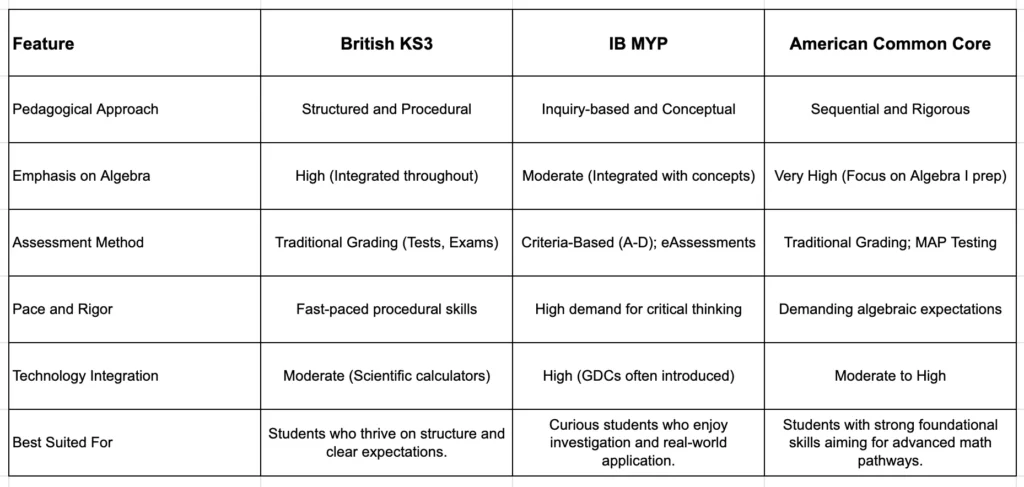
Analyzing the Differences: Rigor, Assessment, and Skills
Rigor and Pace: Which is Hardest?
It is a misconception that one curriculum is universally harder than the others. The rigor manifests differently:
KS3 is rigorous in its expectation of procedural speed and accuracy across a broad range of topics.
MYP is rigorous in its demand for critical thinking, investigation, and the ability to communicate mathematical reasoning (Criteria B and C). Students must adapt to solving unfamiliar problems.
Common Core is rigorous in its deep dive into pre-algebra and algebraic concepts, expecting a high level of mastery before progression.
Assessment Styles: The Grading Challenge
The starkest contrast lies in assessment. KS3 and Common Core rely on objective testing where the primary goal is the correct answer derived through correct methodology.
The MYP’s criteria-based system can feel subjective to students and parents unfamiliar with it. A student might understand the concept (Criterion A) but score poorly because they failed to investigate a pattern thoroughly (Criterion B) or communicate their findings clearly (Criterion C). This requires a significant shift in how students approach their work.
Technology Integration
Technology integration varies. The MYP often introduces Graphic Display Calculators (GDCs) earlier than the British system, preparing students for their heavy use in the DP. Common Core and KS3 typically rely on scientific calculators, emphasizing strong manual calculation skills.
The High School Trajectory: Which Path Leads Where?
The choice of middle school curriculum significantly impacts a student’s readiness for high school pathways.
KS3 to GCSE/A-Levels: KS3 provides the most seamless transition to GCSE and subsequently A-Levels, as the content and assessment style are perfectly aligned.
MYP to IB DP: The MYP is designed to develop the skills needed for the DP. Students are well-prepared for the Internal Assessment (IA) and the rigorous demands of both the AA and AI streams.
- Common Core to AP: The strong foundation in Algebra ensures students are ready for Pre-Calculus and eventually AP Calculus or AP Statistics.
Transition Challenges:
To integrate this effectively, we will slightly modify the second sentence. This connects the specific challenge mentioned (KS3 to IB DP transition) directly to the authoritative resource (the guide), using a dash for emphasis and flow.
While the pathways are designed to be coherent, switching between systems after middle school becomes increasingly challenging. A student moving from KS3 to the IB DP, for instance, will need significant support in adapting to the inquiry-based style—a challenge analyzed in our comprehensive guide to transferring curricula in Dubai.
Making the Right Choice for Your Child
Choosing the right middle school math curriculum depends on your child’s learning style and your long-term educational goals.
Choose KS3 if your child thrives in a structured environment, enjoys clear expectations, and is likely to pursue the GCSE/A-Level pathway.
Choose MYP if your child is naturally curious, enjoys investigation, prefers applying knowledge to real-world problems, and is likely to pursue the IB DP.
Choose Common Core if your child benefits from a sequential, mastery-based approach, shows aptitude for algebra, and is likely to pursue AP courses or apply to US universities.
It is also important to remember that the quality of teaching and the school environment often matter as much as the curriculum itself.
The middle school years are crucial for developing both mathematical skills and confidence. Regardless of the curriculum—KS3, MYP, or Common Core—personalized support can make a significant difference in high school readiness. Our team of expert math tutors in Dubai specializes in all three systems, ensuring students are prepared for the challenges ahead.
Frequently Asked Questions
They are difficult in different ways. KS3 math is often faster-paced and demands higher procedural fluency and speed. IB MYP math demands more critical thinking, investigation (Criterion B), and the ability to communicate mathematical reasoning (Criterion C). Students who rely on memorization often find the MYP more challenging.
The main difference is the philosophy and assessment. MYP is inquiry-based and uses criteria-based assessment, focusing on conceptual understanding in global contexts. Common Core is more sequential and rigorous in its focus on specific standards, particularly Algebra readiness, and uses traditional grading along with standardized tests like MAP.
Yes, MAP (Measures of Academic Progress) testing is widely used in Dubai, particularly in American curriculum schools following Common Core standards. Many IB and British schools also use MAP testing or similar standardized tests (like GL Assessments) to benchmark student progress internationally.
It is critically important. KS3 lays the direct foundation for GCSE mathematics. Students who do not master key KS3 concepts, particularly in Algebra and Number, often struggle significantly with the increased demands and pace of the GCSE curriculum, especially at the Higher Tier.
Yes, but it requires adjustment. MYP students often have strong conceptual understanding but may need to adapt to the sequential nature of the American system (e.g., ensuring they meet the prerequisites for Algebra I or Geometry). They also need to adjust to the traditional assessment style and standardized testing formats.